Fire Alarm Troubleshooting
Why does a commercial fire alarm keep going off?
Is your business fire alarm sounding for no obvious reason? Read about likely causes, what staff should do and when an engineer needs to investigate.
Fire Alarm Troubleshooting
Is your business fire alarm sounding for no obvious reason? Read about likely causes, what staff should do and when an engineer needs to investigate.
Treat each activation as a possible fire until the premises are safe and trained staff have checked. Note the panel zone or device, the time and what was happening nearby. If the alarm sounds again or nobody can explain why, ask a competent fire alarm engineer to investigate. Do not leave a detector or circuit switched off.
If the fire alarm sounds at work, use the site's fire action plan. Do not dismiss a repeat alarm as a fault. Once the building is safe and trained staff have checked for signs of fire, record what happened. If it happens again, get the cause investigated.
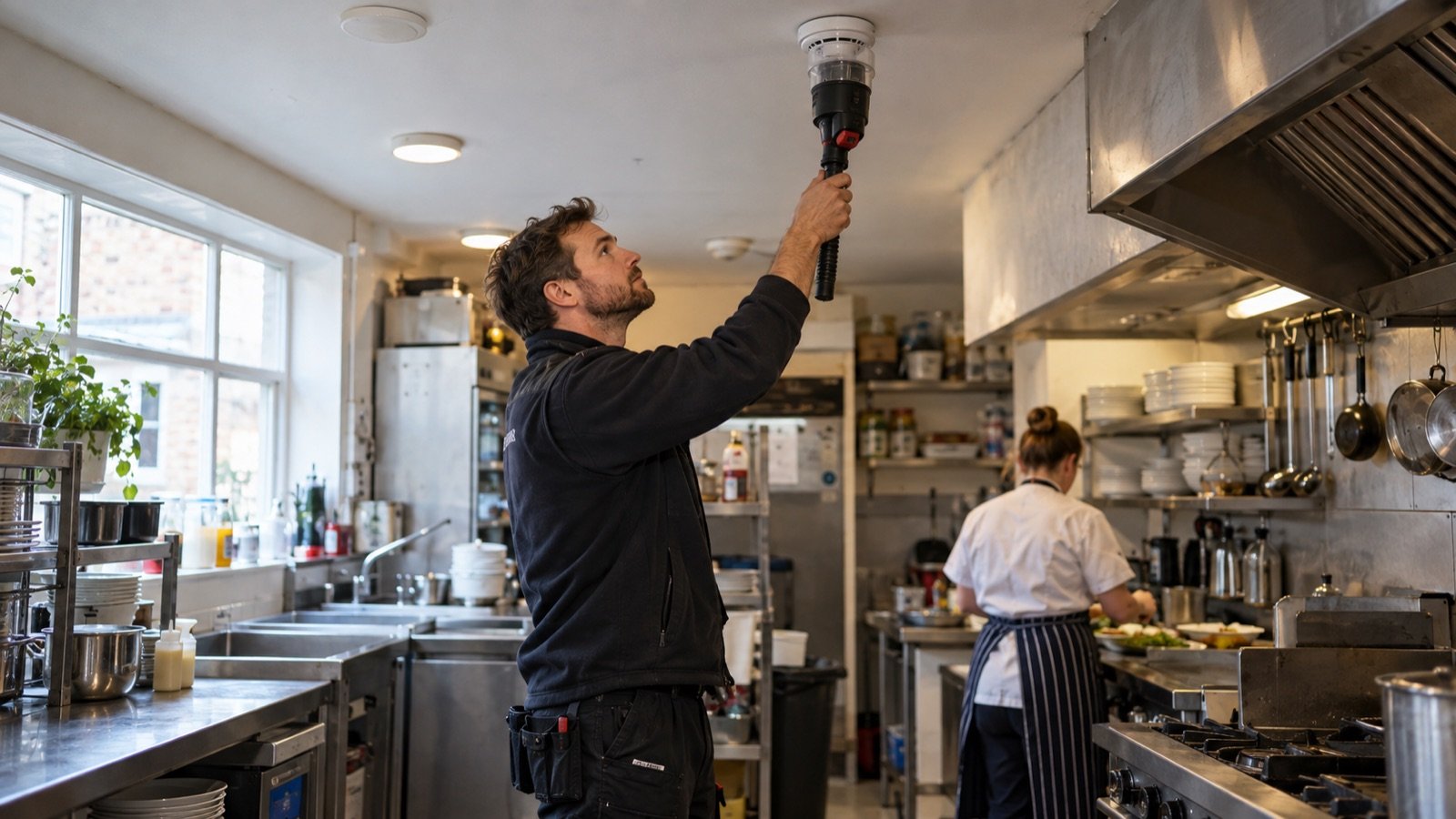
Steam or cooking fumes can set off a detector placed too close to a kitchen. Dust, contractor work, a damaged call point or an electrical fault may also be responsible. The panel can point to a device or zone, but it cannot tell you whether there is a fire.
Alarms that sound without a fire cause disruption. Frequent false alarms can also make people less likely to respond. In England, fire and rescue services attended 255,047 fire false alarms in the year ending March 2026. That was 40% of all incidents and 18% more than five years earlier. The figures cover every type of false alarm, not only faults in commercial systems. See the latest official fire and rescue statistics.
Follow the site's fire action plan and evacuate when required. Call 999 if anyone sees smoke or flames, smells burning or cannot rule out a fire safely. Do not delay while someone searches for the detector or waits for an engineer.
Only trained staff should check the source, and only if the fire plan allows it. Nobody should enter a smoky or unsafe area. Follow the site's instructions to acknowledge or reset the panel. A reset will not explain why the alarm sounded.
Once it is safe, note the time, panel message, device or zone, activity nearby and what staff found. A few entries in the log can make a recurring cause easier to spot.
Start with the panel display and the activity nearby. A false alarm does not always mean the detector is broken.
Steam from a shower or kitchen, cooking fumes and spray cleaners can reach a nearby detector. Check whether the ventilation or room use has changed. Do not cover the detector or change its type yourself. Ask the fire alarm company to check that it suits the area and the fire risk assessment.
Drilling, sanding, dust and paint fumes can set off an alarm. Tell contractors where the devices are and agree the site's fire safety process before work starts. Follow the alarm company's instructions for any temporary protection or isolation. Record it, keep required precautions in place and restore the system as soon as the work is finished.
A storeroom used as a staff kitchen, a new production process, moved shelving or changed ventilation can affect how the detection works. The Home Office's office and shop guidance says to review the alarm design and detector locations when the way a premises is used changes. Review the fire risk assessment too if the change affects fire safety.
A trolley or stock delivery can hit a manual call point. Check its position and what happens nearby. A competent person can advise whether a suitable guard or layout change would help. The call point must remain visible and easy to reach in an emergency.
Dust, insects, water, physical damage or an electrical fault can cause repeated alarms or panel warnings. Do not open, clean or repair a detector unless you are qualified and the manufacturer permits it. Give the engineer the panel message and your log of earlier activations.
If the alarm reports to an Alarm Receiving Centre, tell the centre before a planned test or approved maintenance isolation. Agree who will put the system back into service, then confirm the centre is receiving signals as expected.
Government guidance for offices and shops says to investigate false alarms and deal with their causes. It warns that frequent alarms can make people less likely to respond properly to a real one. Keep the investigation and repair record with the site's fire safety documents. Greater Manchester Fire and Rescue Service gives similar advice for local businesses.
Do not leave a detector, zone or circuit disconnected to stop repeated alarms. The area could be left without the protection expected by the fire risk assessment. If an engineer needs a temporary isolation, follow the site's authorised procedure, put required precautions in place and confirm the system has been restored.
If a fault stays on the panel, or the same area keeps activating, contact a competent fire alarm company. Keep your log handy. FIDEC's guide to commercial fire alarm servicing explains the routine checks, and our team can help with fire alarm maintenance in Manchester.
In England and Wales, the responsible person must put suitable fire precautions in place and maintain the equipment provided. This may be the employer, owner, landlord, occupier or facilities manager. GOV.UK explains who is responsible for workplace fire safety. Scotland and Northern Ireland have separate fire safety laws, so check the guidance for the nation where the site is based.
Record each alarm and deal with the cause. Staff should never be told to ignore the sounders. For local response rules, read when the fire brigade attends a commercial fire alarm. FIDEC also installs commercial fire alarm systems and can arrange a site survey.
Steam, cooking fumes, dust, building work, an accidentally operated call point or a fault can set it off. Note the device or zone and what was happening nearby. Ask a competent engineer to investigate if it repeats or the cause is unclear.
Follow the site's fire procedure and evacuate when required. Call 999 if anyone sees smoke or flames, smells burning or cannot rule out a fire safely. Trained staff may check the source only when the site plan allows it. Nobody should enter an unsafe area.
No. Do not leave a detector or circuit disconnected to stop repeated alarms. Any temporary isolation for maintenance must follow the site's authorised procedure, include required precautions and be restored by an authorised person.
An addressable panel often shows the individual device or its address. A conventional panel may show only the zone. Write down the display and pass it to the engineer.
Not after every activation. Check the device and what was happening nearby first. Steam, dust, a change in room use, damage or a system fault may be to blame. A competent person can tell you whether to clean, repair, move or replace it.