Fire Alarm Maintenance
How often should a commercial fire alarm be serviced?
Commercial fire alarms should normally be serviced every six months by a competent specialist, with weekly user tests and daily panel checks between visits.
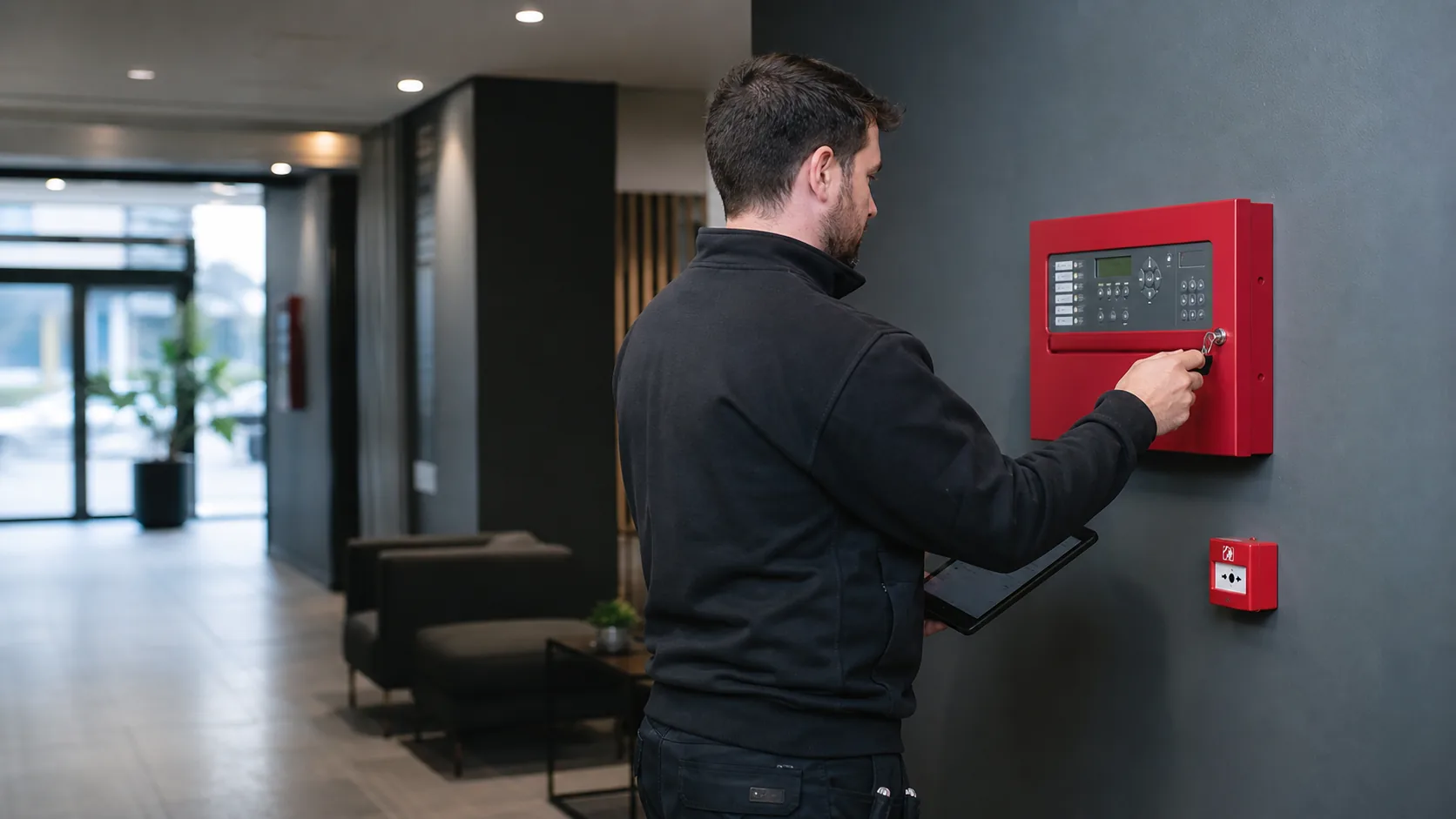
Fire Alarm Maintenance
Commercial fire alarms should normally be serviced every six months by a competent specialist, with weekly user tests and daily panel checks between visits.
For most UK commercial premises, arrange professional fire alarm servicing at least every six months. Daily checks, weekly alarm tests, fault logging, and prompt repairs still sit with the responsible person between service visits.
A commercial fire alarm should normally be serviced by a competent specialist at least every six months. That is the simple answer for most UK workplaces, shops, warehouses, offices, hospitality sites, schools, and industrial premises.
Six-monthly servicing is not the only check that matters. It sits alongside daily visual checks of the panel, weekly user tests, fault reporting, logbook updates, and any extra maintenance required by your fire risk assessment, insurer, enforcing authority, or system design.
The reason is straightforward. A fire alarm is only useful if it works on the day you need it. Dusty detectors, tired batteries, damaged call points, disabled devices, missed faults, poor sounder coverage, and signalling problems can all leave a system looking normal from the outside while quietly becoming unreliable.
For non-domestic premises, the recognised standard is BS 5839-1, the code of practice for fire detection and fire alarm systems in commercial buildings. The Fire Industry Association says the period between successive inspection and servicing visits should not exceed six months. If that recommendation is not followed, the system should be treated as no longer compliant with that part of BS 5839.
The 2025 update also reflects normal industry practice around planned visits. In plain terms, a competent fire alarm company should service the system on a roughly six-monthly cycle, not leave it drifting for most of the year and then try to catch up with paperwork.
The practical rule: book two professional fire alarm service visits per year, spaced about six months apart. For higher-risk or more complex sites, ask for a risk-based servicing schedule rather than assuming two visits is enough.
Answer first: for most commercial premises, plan for professional servicing at least every six months, then add daily panel checks and weekly user tests between engineer visits.
2026, FIA guidance: the Fire Industry Association says the recommended period between fire alarm inspection and servicing visits should not exceed six months.
2026, MHCLG statistics: fire and rescue services in England attended 252,162 fire false alarms in the year ending December 2025. Of those, 169,153 were due to apparatus.
"should not exceed six months" Fire Industry Association, Maintaining your fire alarm system, accessed 2026.
What this means for facilities managers: six-monthly servicing is the baseline, not the whole regime. False alarms, dirty detectors, disablements, and signalling faults need active management between visits.
Under the Regulatory Reform (Fire Safety) Order 2005, the responsible person must make sure fire detection and warning equipment is subject to a suitable system of maintenance and kept in efficient working order. GOV.UK guidance also makes fire detection and warning systems part of the fire risk assessment process.
That makes servicing an operational check, not an admin task for the contractor. The responsible person still needs to make sure checks happen, faults are acted on, records are kept, and the system remains suitable for the building as the site changes.
If the building layout changes, if occupancy increases, if a dusty process is introduced, if a kitchen expands, or if a new area is used for sleeping, storage, charging, or plant, the alarm may need more than routine servicing. It may need a design review.
Professional servicing every six months does not replace user checks. GOV.UK fire safety guidance for offices and shops says fire detection and warning systems should be tested weekly in line with manufacturer or installer instructions. It also says the control and indicating equipment should be checked at least every 24 hours to confirm there are no specific faults.
| Check | Usual frequency | Who normally owns it |
|---|---|---|
| Panel status check | Daily, or every occupied day | Responsible person or trained site team |
| Manual call point user test | Weekly, rotating call points | Responsible person or trained site team |
| Professional inspection and servicing | At least every six months for most sites | Competent fire alarm specialist |
| Risk-based design review | After layout, occupancy, process, or use changes | Responsible person with competent advice |
Many straightforward commercial sites are well served by two visits per year. Some are not. A higher servicing frequency may be sensible where the environment is harsh, the building is complex, or the consequences of failure are unusually serious.
The fire risk assessment should drive the final answer. If your risk assessment says the alarm is a central control measure, the maintenance schedule should reflect that.
A service visit should be more than a quick panel check. The engineer should inspect and test the system in line with BS 5839-1 and the system's documentation. Across the annual cycle, the whole system should be properly covered.
After the visit, you should receive a service report or certificate that states what was tested, what was found, what needs remedial work, and whether any part of the system was left impaired.
Use a competent fire alarm specialist. BAFE says responsible persons should be able to show due diligence when sourcing competent providers, and it strongly recommends using an appropriately third-party certificated organisation. For fire detection and fire alarm systems, BAFE SP203-1 covers design, installation, commissioning, and maintenance, with modules that should be checked for the service you need.
In practical terms, ask the contractor whether they maintain systems to BS 5839-1, whether they hold third-party certification for maintenance, what their engineer response process looks like, and what documentation you will receive after each visit.
Good records matter because they show that the system is being managed rather than only occasionally looked at. Keep the fire alarm logbook, service certificates, fault reports, false alarm investigations, detector disablement records, and any design or variation documents together.
This is useful during audits, insurer checks, fire risk assessment reviews, and enforcement visits. It is also useful for your own team. If the same detector causes problems three times in six months, the logbook should make that obvious.
Service your commercial fire alarm every six months as the normal minimum. Check the panel daily. Test the alarm weekly. Record activations, faults, and repairs. Use a competent specialist, ideally one with appropriate third-party certification for fire alarm maintenance. Increase the frequency if your risk assessment, site conditions, false alarm history, insurer, or enforcing authority points that way.
If your last service was more than six months ago, or if you are not sure whether the alarm logbook and certificates are current, treat that as a live compliance gap.
FIDEC maintains commercial fire alarm systems across Manchester and the UK, including planned six-monthly servicing, fault call-outs, system reviews, and joined-up checks where alarms interface with access control, CCTV, monitoring, or other life safety systems.
View FIDEC maintenance contracts or contact FIDEC Security Solutions for a free site survey. Call 0333 3662 007 or email info@fidecss.co.uk.
Most commercial fire alarm systems should be inspected and serviced at least every six months by a competent fire alarm engineer, unless the risk assessment, insurer or system condition calls for more frequent visits. Weekly user tests should still be completed by the premises team between engineer visits. Keep both sets of records because they answer different compliance questions.
The responsible person for the premises must make sure suitable fire safety arrangements are in place, which includes keeping the fire alarm maintained where one is provided. In practice this may be handled by the owner, landlord, facilities manager, managing agent or employer. The key point is that someone must own the diary, records and remedial actions.
A service visit normally checks the panel, zones, detectors, call points, sounders, batteries, fault history and records, then tests a sample or agreed proportion of devices depending on the visit plan. The engineer should record what was tested, note defects and explain remedial work. A useful visit leaves the responsible person with clear next steps, not vague warnings.
Yes. A missed service can leave faults unnoticed, weaken audit records and make it harder to prove the system was being maintained properly if there is an incident, insurer query or enforcement visit. The practical fix is to book the overdue visit, record the reason for the gap and act on any defects found during testing.