Fire Extinguishers
How Many Fire Extinguishers Does a Business Need?
Calculate how many fire extinguishers a UK business needs using the 200 square metre rule, floor minimums, fire ratings and hazard-specific equipment.
Fire Extinguishers
Calculate how many fire extinguishers a UK business needs using the 200 square metre rule, floor minimums, fire ratings and hazard-specific equipment.
For an ordinary Class A risk, government guidance uses one 13A-rated water-based extinguisher for about every 200 square metres, normally with at least two extinguishers on each floor. That is a starting point, not a shopping list. The fire risk assessment must also account for kitchens, electrical equipment, flammable liquids, workshops, travel distance, layout and the people expected to use the equipment.
Most ordinary UK workplaces use one 13A-rated water-based fire extinguisher for about every 200 square metres of floor space, with at least two extinguishers on each floor. That is the usual starting point for Class A risks such as paper, cardboard, wood and textiles.
The final number can be higher. Kitchens, electrical equipment, flammable liquids, machinery, workshops and awkward layouts can all require extra extinguishers of a different type. Your fire risk assessment decides what the premises needs.
A two-storey office measuring 150 square metres on each floor would normally start with four Class A extinguishers: two on the ground floor and two on the first floor. A server room, commercial kitchen or workshop may need additional equipment for its own risk.
For a typical office, shop or similar low-risk workplace, use this as an initial check:
The extinguisher count is based on fire rating, not simply the number of red cylinders. A compact water-additive unit may carry the same 13A rating as a larger traditional water extinguisher. Check the rating printed on the extinguisher rather than assuming its capacity tells you how much protection it provides.
Class A covers fires involving ordinary solid materials, including paper, cardboard, wood and many textiles. Government guidance for offices and shops says one water-based extinguisher for approximately every 200 square metres will normally be adequate, with a minimum of two extinguishers per floor.
A commonly used 13A extinguisher is rated against a standard test fire. The number does not mean it lasts for 13 minutes or covers 13 rooms. It is a performance rating.
| Example floor | Basic calculation | Usual starting provision |
|---|---|---|
| 80 m² ground-floor shop | Less than 200 m² | Normally two Class A extinguishers, unless the risk assessment supports a small-premises exception. |
| 350 m² office floor | 350 ÷ 200 = 1.75 | At least two suitable 13A extinguishers. |
| 650 m² warehouse floor | 650 ÷ 200 = 3.25 | At least four suitable 13A extinguishers, subject to layout and risk. |
| Two floors of 150 m² each | Calculate each floor separately | Normally two extinguishers per floor, four in total. |
Always round up, then check the layout. Four extinguishers grouped by one door do not give useful coverage across a long or divided warehouse.
Sometimes. Some government premises guides allow one suitable extinguisher in a very small, self-contained premises under 90 square metres where the fire risk assessment supports it. This is an exception, not a blanket rule for every small office or shop.
The decision should consider the floor plan, escape route, work carried out, ignition sources and whether the single unit can deal with the likely fire types. A small takeaway kitchen and a small stationery office may have the same floor area but very different needs.
The Class A calculation only covers ordinary combustible materials. Add equipment where the assessment identifies another fire type or a localised hazard.
| Risk | Common extinguisher choice | Important point |
|---|---|---|
| Computers, control panels and other electrical equipment | CO2 | Place it close enough to reach safely. A CO2 unit does not replace the floor's Class A provision. |
| Commercial deep-fat cooking | Wet chemical, often with a fire blanket where suitable | Water, foam and standard powder can be dangerous on hot cooking oil. |
| Petrol, diesel, paint or other flammable liquids | Foam or another medium selected for the actual liquid risk | Get competent advice on free-flowing liquids and the size of the hazard. |
| Flammable gases | Specialist selection | Isolating the gas supply is usually central to the response. The assessment must cover this. |
| Combustible metals | Specialist Class D extinguisher | The medium must match the metal. Ordinary extinguishers may worsen the fire. |
Dry powder can knock down several types of fire, but it can obscure vision, affect breathing and spread residue through equipment. It is not usually a good default choice inside offices, shops or other enclosed occupied spaces.
General-use extinguishers should normally sit on escape routes, near a room exit, floor exit or final exit. Someone using one should be able to keep a safe route behind them. Equipment for a specific hazard should be near that hazard, but not so close that a fire blocks access to it.
Government guidance says nobody should ideally have to travel more than 30 metres to reach an extinguisher. Walls, locked doors, racking and changes of level matter more than a straight-line measurement on a plan.
Extinguishers should be easy to see and mounted on a wall or suitable stand. Do not hide them behind stock, leave them loose on the floor or move them to make space for furniture. Signs may be needed where the position is not obvious.
Portable extinguishers need a basic service by a competent person every year. BS 5306-3:2017 is the current British Standard for commissioning and maintenance. Your business should also carry out simple visual checks between services, usually monthly in normal conditions.
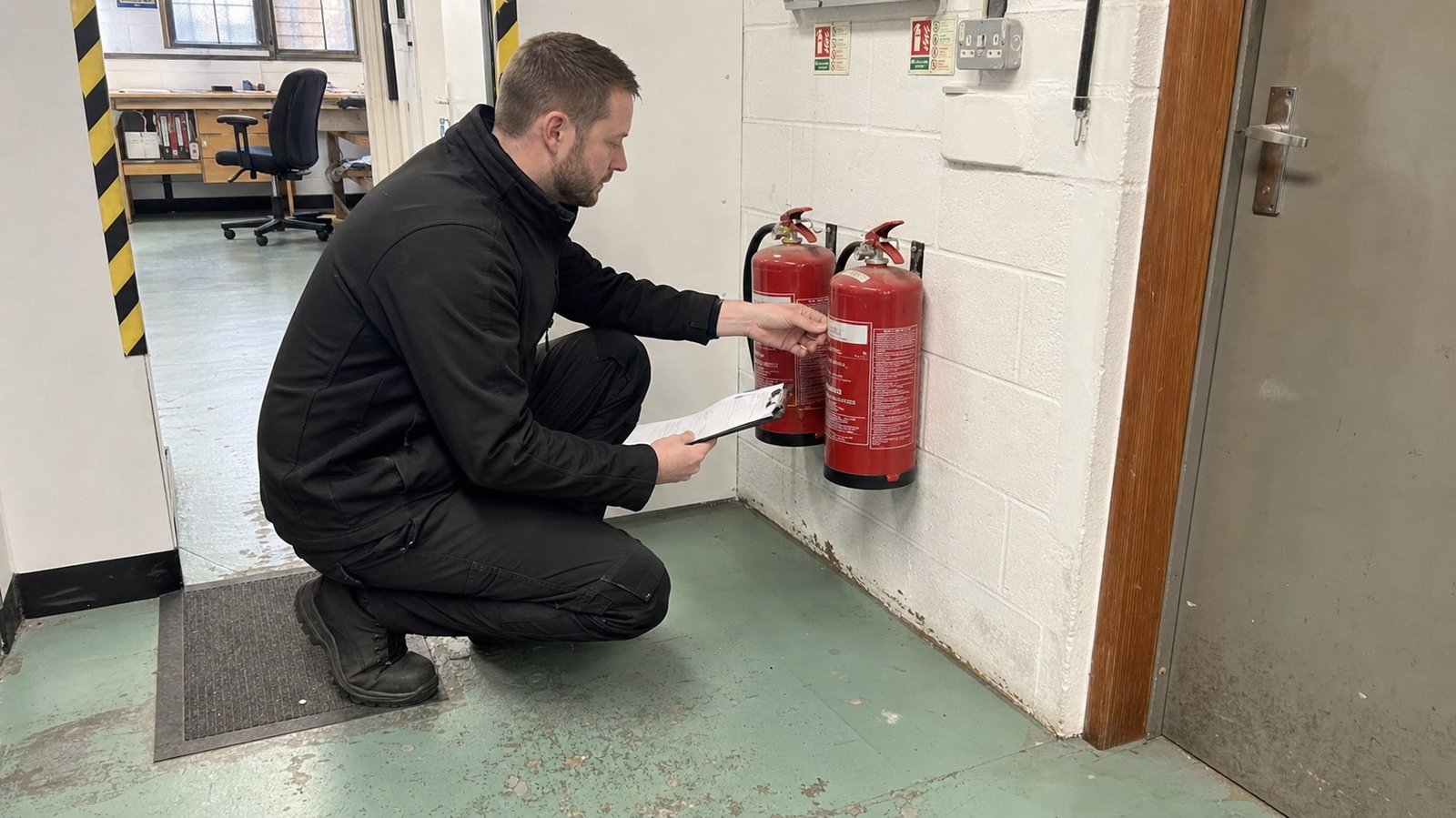
The routine check should confirm that each extinguisher is in its assigned place, unobstructed, apparently undamaged, still sealed and showing an acceptable pressure where a gauge is fitted. Record the check and deal with missing or damaged equipment promptly.
Some extinguishers also need an extended service or replacement at longer intervals. The timing depends on the extinguisher type and condition. See our guide to fire extinguisher servicing intervals for the monthly, annual, five year and ten year checks.
In England and Wales, the responsible person must carry out and regularly review a fire risk assessment, put suitable fire precautions in place and maintain them. The responsible person may be the employer, owner, landlord, occupier, facilities manager or another person with control of the premises. Shared buildings can have more than one responsible person, and they must coordinate.
Scotland and Northern Ireland have separate fire safety legislation, but the practical approach remains risk based: assess the premises, provide suitable equipment and keep it maintained. If you manage sites in more than one UK nation, make sure the assessment refers to the law and guidance that apply at each address.
A useful survey should leave you with a schedule, not just a price. It should list each extinguisher's location, type, rating and service status, explain any additions or removals, and show how the recommendation follows the current fire risk assessment.
Ask the provider to identify obsolete, damaged or unsuitable equipment and explain any specialist risks that need input from the fire risk assessor. If the premises has changed since the assessment was written, update the assessment before treating the equipment schedule as final.
FIDEC surveys, supplies, positions and services portable fire extinguishers for commercial premises. We can review an existing schedule, replace unsuitable units, label equipment and provide service records for single or multi-site businesses.
For fire extinguisher servicing in Manchester or wider planned work, book a free site survey through our contact page, call 0333 3662 007, or email info@fidecss.co.uk.
For ordinary Class A risks, government guidance uses one 13A-rated water-based extinguisher for approximately every 200 square metres of floor space, normally with at least two extinguishers on each floor. The fire risk assessment may require more equipment for the layout or for kitchens, electrical equipment, flammable liquids and other specific hazards.
Two suitable extinguishers per floor is the normal starting point in government guidance. Some very small, self-contained premises under 90 square metres may use one suitable extinguisher where the fire risk assessment supports that decision. Larger or higher-risk floors may need more than two.
No. The 200 square metre rule is for Class A protection using water-based extinguishers with a suitable rating. A CO2 extinguisher may be added near electrical equipment, but it does not replace the floor's basic Class A provision.
Government guidance says nobody should ideally have to travel more than 30 metres to reach an extinguisher. General-use units should normally be on escape routes or near exits. Equipment for a specific hazard should be nearby but positioned so the fire cannot block safe access to it.
Portable fire extinguishers should receive a basic service by a competent person every year. The business should also make routine visual checks between services, usually monthly in normal conditions, and record missing, damaged or discharged equipment.