Fire Safety
Fire Risk Assessment Law for UK Businesses
A plain guide to UK fire risk assessment law, responsible person duties, 5 steps, April 2026 rule changes and common compliance gaps.
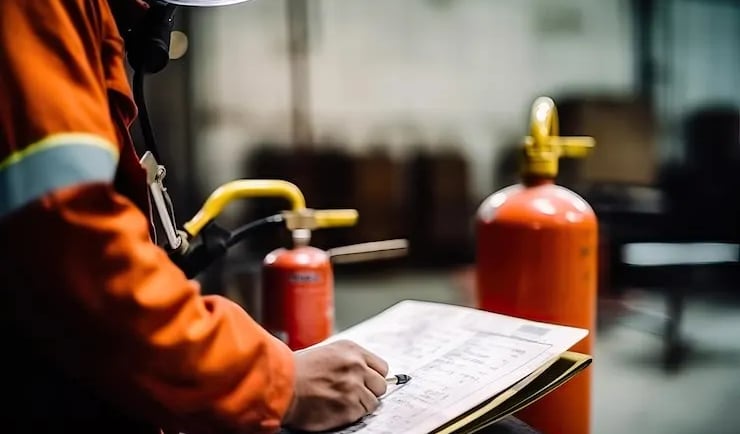
Fire Safety
A plain guide to UK fire risk assessment law, responsible person duties, 5 steps, April 2026 rule changes and common compliance gaps.
A fire risk assessment is a live control document, not a form to file away. It should identify the hazards, people at risk, emergency plan, maintenance actions and review triggers, then drive the fire alarm, extinguishers, escape routes, training and any remedial work.
If you are responsible for fire safety at commercial premises in England or Wales, you need a written fire risk assessment that reflects the building and how people use it. This guide explains the core duty, the review process and the separate residential evacuation rules that took effect in England in April 2026.
Yes. Unambiguously.
The Regulatory Reform (Fire Safety) Order 2005 is the main piece of legislation governing fire safety in buildings in England and Wales. It applies to all workplaces and the common parts of buildings containing two or more domestic premises. It places legal duties on anyone in control of these premises to carry out and record a fire risk assessment and put in place and maintain general fire precautions.
That covers offices, warehouses, retail units, workshops, restaurants, care homes, schools: essentially any non-domestic premises you can think of.
A suitable and sufficient fire risk assessment must be completed and fully recorded, regardless of building size or number of employees. If your fire risk assessment exists only in your head, or was never written down, it is not legally compliant. Full stop.
2026, GOV.UK guidance: the responsible person must carry out and regularly review a fire risk assessment, and must keep a written record.
2026, MHCLG statistics: fire and rescue services in England attended 40,350 building fires in the year ending December 2025.
"You must keep a written record" GOV.UK, Fire risk assessments, accessed 2026.
What this means for facilities managers: the assessment is the control document for alarms, escape routes, training, maintenance, contractor work, and action tracking. A generic file that nobody uses is weak evidence.
The "responsible person" is whoever has control of the premises: this often includes employers, building owners, landlords, and facilities managers. In multi-occupancy buildings, responsibilities may overlap and must be clearly defined and coordinated between parties.
Appointing an assessor does not transfer the responsible person's duties under the Fire Safety Order. The responsible person should check that the assessor is competent and act on the findings.
The Fire Safety (Residential Evacuation Plans) (England) Regulations 2025 came into force on 6 April 2026. They apply in England to buildings with at least two domestic premises that are at least 18 metres high or have at least seven storeys. They also cover buildings over 11 metres where a simultaneous evacuation strategy is in place. The regulations contain detailed scope and exceptions that responsible persons should check for each building.
Under the new regulations, the responsible person must take steps to identify residents who might not be able to leave the building without help in a fire. Where such residents are identified, they must be offered a person-centred fire risk assessment, and the responsible person must develop and maintain a building-wide emergency evacuation plan.
These regulations concern residential buildings. They do not create a new general RPEEP duty for every commercial workplace. Existing fire risk assessment and emergency planning duties still require responsible persons to consider people who may need help to evacuate.
Every fire needs three things: a source of ignition, a source of fuel, and oxygen. Step one is about understanding where all three exist in your premises.
This step is not a headcount. It is about understanding who is in your building and whether anyone faces particular risk. Consider employees in higher-risk areas, lone workers, people on site outside normal hours, visitors unfamiliar with the building, contractors, delivery personnel, and anyone with a disability or mobility impairment who may need additional help to evacuate.
Having identified the hazards and the people at risk, step three requires you to evaluate how serious each risk is and decide what to do about it. Some risks can be removed entirely. Others can be reduced through changes to processes, storage arrangements, or maintenance schedules.
Fire precautions are the measures that protect people once a fire has started, including your alarm and detection system, means of escape, emergency lighting, fire-fighting equipment, and evacuation procedures. The risk assessment and the fire safety systems in your building are not separate considerations. One should directly inform the other.
A suitable and sufficient fire risk assessment must be fully recorded. Failing to adequately document findings can itself be treated as a breach of the law. You must document how fire safety is planned, controlled, monitored, and reviewed: beyond just the risk assessment findings.
Beyond the document itself, you need an emergency plan setting out what people should do when a fire is discovered, how evacuation should work, the roles of fire wardens, how the fire service is called, and specific arrangements for people who need assistance.
Staff training sits within this step too. Employees need suitable fire safety instruction, and the emergency plan should be tested often enough for the risks and use of the premises. GOV.UK guidance should be checked for the building type.
A fire risk assessment is not a one-off task. UK fire safety legislation does not define a specific review period: it requires assessments to be reviewed regularly and updated whenever they are no longer valid.
Many organisations schedule an annual review, but the law does not set that interval. Review sooner if the assessment may no longer be valid, including after these changes:
| Trigger | What to update | Why it matters |
|---|---|---|
| Layout or use changes | Escape routes, occupancy assumptions, detector coverage, signage, and staff procedures. | The old assessment may no longer describe the building people actually use. |
| New plant, stock, charging, or hot works | Ignition sources, fuel load, isolation procedures, alarm interfaces, and extinguisher provision. | New work can change both the likelihood of fire and the speed of spread. |
| Alarm, extinguisher, or access control changes | Fire precautions, maintenance records, door release arrangements, and staff instructions. | Safety systems only help if the assessment and procedures reflect how they operate. |
The law requires the assessment to be carried out by a "competent person." There are no prescribed qualifications. The test is whether the person has sufficient training, experience, and knowledge for the type of premises involved.
For small, low-risk premises, an informed business owner can carry out their own assessment using government guidance. For larger, more complex, or higher-risk environments, appointing a professional assessor is the more defensible choice.
PAS 79-1:2020 provides a methodology for fire risk assessments in premises other than housing. It is not a legal qualification. When appointing an assessor, ask for evidence of competence, relevant experience, insurance and any third-party registration they rely on. Check the register and its scope directly.
If your premises needs a fire alarm system that reflects the risks identified in the assessment, FIDEC installs and maintains commercial fire alarm systems. Contact FIDEC Security Solutions, call 0333 3662 007, or email info@fidecss.co.uk.
The responsible person is usually the employer, building owner, landlord, occupier or anyone with control of the premises, depending on how the site is managed. They must make sure a suitable fire risk assessment exists and that significant findings are acted on. The duty cannot be solved by filing a report and ignoring the actions.
A fire risk assessment should be reviewed regularly and whenever there is a significant change to the premises, people, work activity or fire precautions. There is no single interval that fits every site, but annual review is common for many businesses. Changes such as refurbishment, new storage, staffing changes or repeated false alarms should trigger a fresh look.
No. A fire risk assessment identifies risks and required precautions, while fire alarm maintenance checks that the alarm system continues to work and remains properly recorded. Both matter. If the assessment says a fire alarm is needed, the responsible person still needs suitable testing, servicing, defect action and documentation to show the system is being managed.
Ignoring fire safety actions can leave people at risk and expose the business to enforcement, insurer problems and serious consequences after an incident. Actions should be prioritised, assigned and tracked until complete. If a recommendation involves alarms, emergency lighting, extinguishers or access control on escape routes, get competent advice before choosing the cheapest fix.