Fire Safety
Lithium Battery Charging Fire Safety for Businesses (2026)
A practical UK business guide to reducing lithium battery charging fire risk, including zoning, charging rules, training and assessment updates.
Fire Safety
A practical UK business guide to reducing lithium battery charging fire risk, including zoning, charging rules, training and assessment updates.
If lithium battery charging happens on your site, it should be explicitly controlled in your fire risk assessment, charging policy, and staff training.
Lithium battery risk has moved from a niche issue to a mainstream facilities problem for UK businesses. If your site has e-bikes, e-scooters, power tools, handheld scanners, radios, or backup battery packs, you already have this risk in your building.
In January 2026, London Fire Brigade reported a record number of e-bike and e-scooter incidents in 2025 and repeated its call for tighter product regulation. At the same time, UK Government and fire sector guidance continues to stress that poor quality, modified, damaged, or mismatched batteries and chargers are the biggest risk factors.
For employers and responsible persons, this risk is no longer confined to home safety. It is now a workplace fire prevention and business continuity issue.
Three factors are driving boardroom attention this year.
For business premises, the most useful starting point is Government guidance on managing fire risk from e-cycle and e-scooter batteries in premises. It links risk controls to legal duties under the Regulatory Reform (Fire Safety) Order 2005 and asks responsible persons to assess charging, storage, and evacuation risk properly.
Government campaigns such as Buy Safe, Be Safe focus on practical controls including product compliance marks, correct chargers, and avoiding unsafe charging behaviour. London Fire Brigade and other services have added operational guidance for responsible persons to help convert those principles into site rules.
If your current fire risk assessment does not explicitly cover lithium battery charging and storage, it is likely out of date for many modern workplaces.
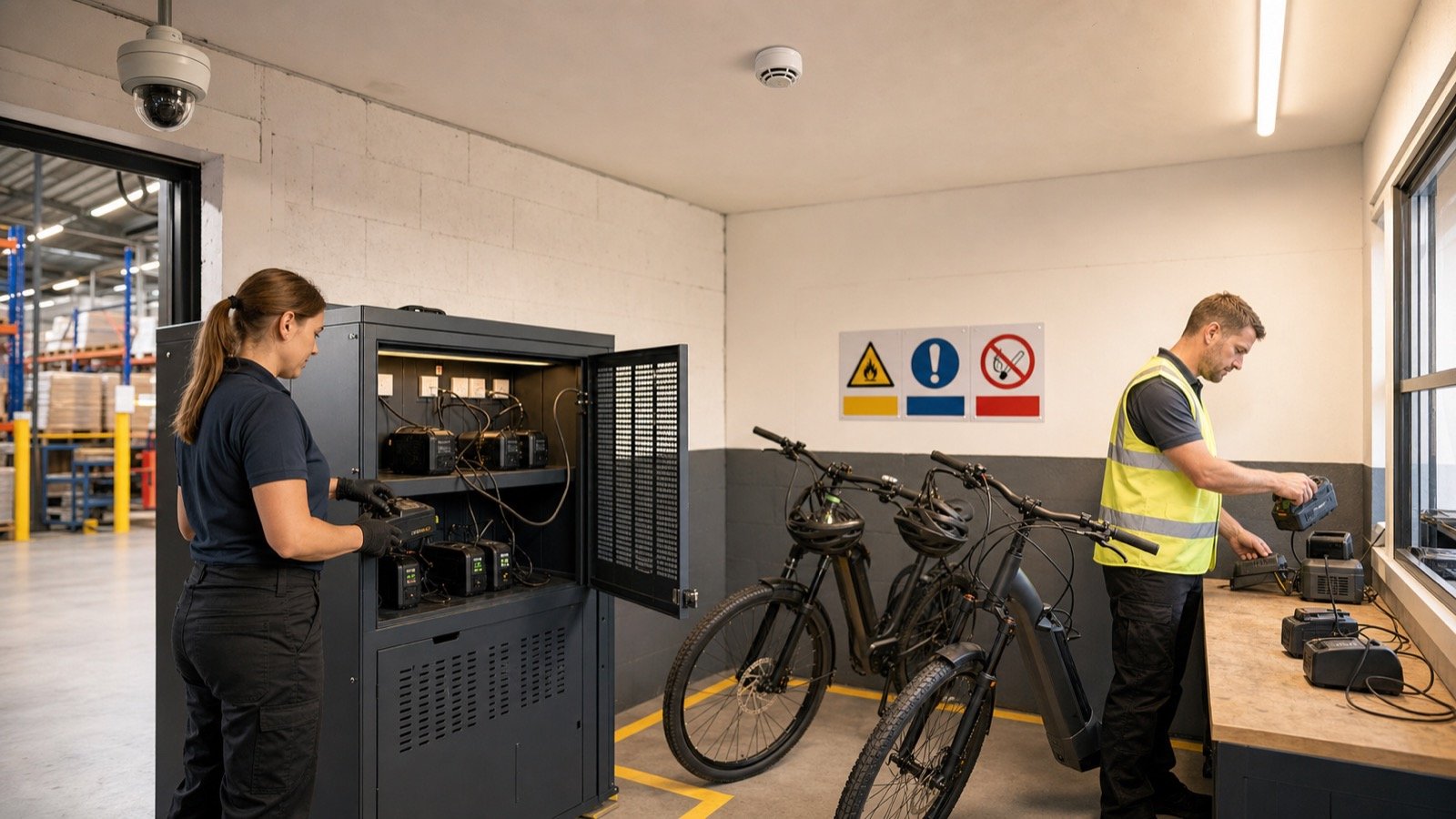
Do not allow ad hoc charging in corridors, fire exits, stair cores, reception desks, or plant access routes. Set a designated charging area with clear separation from escape routes and combustible materials.
Only buy batteries, chargers, and conversion components from reputable suppliers. Check for UKCA or CE compliance marks where applicable, and block unknown marketplace imports from being brought into operations without approval.
A common failure pattern is mismatched chargers and batteries. Site policy should require original or manufacturer approved chargers only, with visual checks during inspections.
Swelling, impact damage, overheating, unusual smell, smoke, or repeated charging faults should trigger immediate quarantine and removal from service.
Avoid unattended overnight charging where possible. Build charging windows into shift routines so teams can supervise and intervene early if there are warning signs.
Staff should know escalation steps, alarm activation, evacuation actions, and who to contact. Training should be short, role-specific, and repeated for new starters.
Fire detection, compartmentation, access control, and evacuation procedures should be reviewed together. If charging areas have expanded since your last alarm service review, update system coverage and documentation.
We help commercial and industrial clients review the fire and security systems around battery charging areas, including fire alarms and access control. The site fire risk assessment should set the wider charging and evacuation controls.
If your site now has regular battery charging activity, this is the right time to review controls before an avoidable incident forces urgent changes.
Contact FIDEC Security Solutions for a free site survey or fire and security review. Call 0333 3662 007 or email info@fidecss.co.uk.
The main risk is that a damaged, poor-quality, overloaded or incorrectly charged lithium battery can overheat and enter thermal runaway, which can produce a fast, difficult fire. For businesses, the concern is where charging happens, what is nearby and whether staff would spot a problem early. Treat charging as a managed activity, not background clutter.
Businesses should charge lithium batteries in a controlled area away from escape routes, combustible stock, waste, public areas and unattended high-risk locations. The area should have suitable sockets, clear spacing, supervision, and a simple rule for damaged batteries or chargers. If charging is frequent or high-volume, document the arrangement in the fire risk assessment.
They often need suitable fire detection nearby, but the right approach depends on the premises, battery quantity, charging location and existing alarm coverage. A small office charging a few devices is different from a warehouse charging tools, e-bikes or handling equipment. Review detection, staff response and maintenance together so the alarm helps people act quickly.
Staff should stop using a damaged, swollen, leaking, hot or suspect battery and move it into the agreed safe process for the site. Do not keep charging it, leave it on a desk or place it near combustibles. The business should have a clear reporting route, isolation point and disposal process for suspect batteries.