Access Control
Access Control Systems for UK Businesses (2026)
Everything UK businesses need to know about access control systems in 2026: types, costs, compliance, and how to choose the right installer.
Access Control
Everything UK businesses need to know about access control systems in 2026: types, costs, compliance, and how to choose the right installer.
Access control is mainly about control after things change: staff leave, keys go missing, doors are added, and fire routes need to release properly. Choose the door hardware, credentials, software, fire interface and maintenance plan together, because a cheap reader on the wrong door can become an expensive compliance problem.
Most businesses replace their mechanical locks after a break-in, a staff member loses a key, or a disgruntled ex-employee walks back in through a side door. By that point, the upgrade is urgent and the decision gets rushed. This guide is for the managers who want to avoid that situation.
Access control now ranges from a keypad on one internal door to a networked system covering several buildings. The useful starting point is the door, the people using it and what must happen during normal use, a power failure and an emergency.
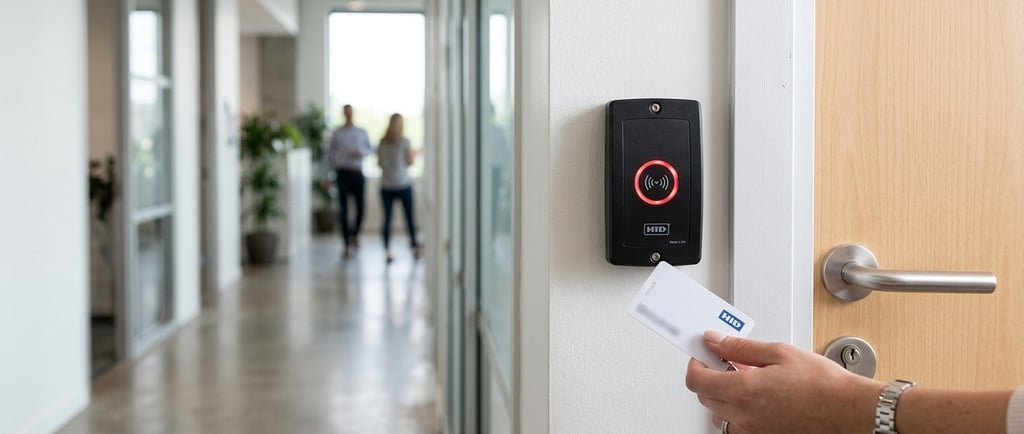
An access control system replaces mechanical locks with an electronic layer that decides who can enter a building, floor, or specific area, when they can do so, and under what conditions. Instead of a key, staff use a credential: a card, a fob, a PIN, a biometric identifier, or a smartphone. The system logs every access attempt in real time and lets an administrator grant or revoke access instantly.
An electronic credential can usually be revoked without changing the physical lock. The time and cost depend on the system, administrator access and door hardware, so ask the installer to show the exact leaver process at handover.
Modern systems also integrate with your CCTV, intruder alarms, and fire detection. When an alarm triggers, access-controlled doors can release automatically to allow evacuation. When a CCTV alert is raised, the access log tells you immediately who was in that area.
There is no dependable national price per door. A quote can change with the lock, door and frame condition, reader, controller, power supply, cabling, fire alarm interface, emergency release, software, licences, commissioning and making good.
Ask every installer to price the same written door schedule. Cloud services may charge by door, controller, user or site, so compare the full contract term and confirm what continues to work if the subscription or internet connection stops.
BS EN 60839-11-1:2013 is the current BSI standard for the minimum functionality, performance and testing of electronic access control systems and components. A project may also need to account for building regulations, fire safety requirements, door hardware standards, the fire strategy and the risk assessment.
Do not assume every controlled door should unlock in the same way. NPSA guidance says the means of escape should not depend on the access control system. The correct arrangement depends on the door, lock, occupancy and emergency plan, and it must allow people to escape safely.
If the system uses fingerprints or facial recognition to identify workers, the ICO treats that as special category biometric data. The organisation needs a lawful basis, a special category condition and a DPIA completed before processing starts. The ICO also says employers should consider a non-biometric alternative.
Wired and wireless products can both be suitable. The choice depends on the door, cable routes, traffic, required event reporting, battery management, radio conditions and how quickly a fault needs to be reported.
Wireless cylinders and escutcheons can reduce cable work on some doors. They do not remove the need to survey the opening, agree permissions, plan battery replacement and test how events reach the management system.
The trade-off is long-term reliability. Wireless devices depend on battery power and radio communication: both of which require attention and maintenance that wired systems do not. For high-traffic doors or external perimeter doors in exposed environments, wired systems still have an advantage.
Access control systems require regular maintenance to stay compliant and functional. Battery-powered wireless devices need checking and replacing on a schedule. Fire interfaces need testing periodically to confirm that doors release correctly when an alarm activates. Software needs updating to address security vulnerabilities, particularly for cloud-connected systems.
The maintenance interval should follow the system design, manufacturer instructions, site risk and any applicable contract or certification scheme. The proposal should state what will be tested and how faults, batteries and emergency release functions will be recorded.
If keys are difficult to control, staff changes create risk or the current system no longer has reliable support, a door-by-door survey is a sensible starting point. It should identify the lock, escape arrangement, users, event records, network needs and maintenance responsibilities before anyone prices the work.
FIDEC Security Solutions installs and maintains access control systems for commercial premises. We also install fire alarms, intruder alarms and CCTV, with planned maintenance available by scope. Call 0333 3662 007 or email info@fidecss.co.uk to discuss a survey.
The right access control system depends on the doors, users, risk areas, visitor flow and how quickly permissions need to change. Many businesses need controlled staff entrances, stock rooms, offices or plant areas rather than every door on site. Start with who needs access, when they need it and what should happen when someone leaves.
Often, yes. Existing doors can frequently be upgraded with suitable readers, locks, releases, controllers or door hardware, but the door and frame need checking first. Fire escape routes, door condition, power, cabling and daily use all affect the design. A survey should confirm whether the door is suitable or needs repair before equipment is fitted.
Yes. Access control helps businesses remove or change permissions without collecting keys, replacing locks or relying on informal handovers. That is useful when staff leave, contractors finish, shifts change or a tenant area is reorganised. The benefit depends on good user management, named credentials and a process for reviewing who still needs access.
Yes. Readers, locks, door releases, batteries, controllers, credentials and software should be checked so small faults do not become access problems or security gaps. Maintenance is especially important on busy doors and escape routes. A good visit checks operation, records faults and confirms whether user permissions still match how the site is used.