
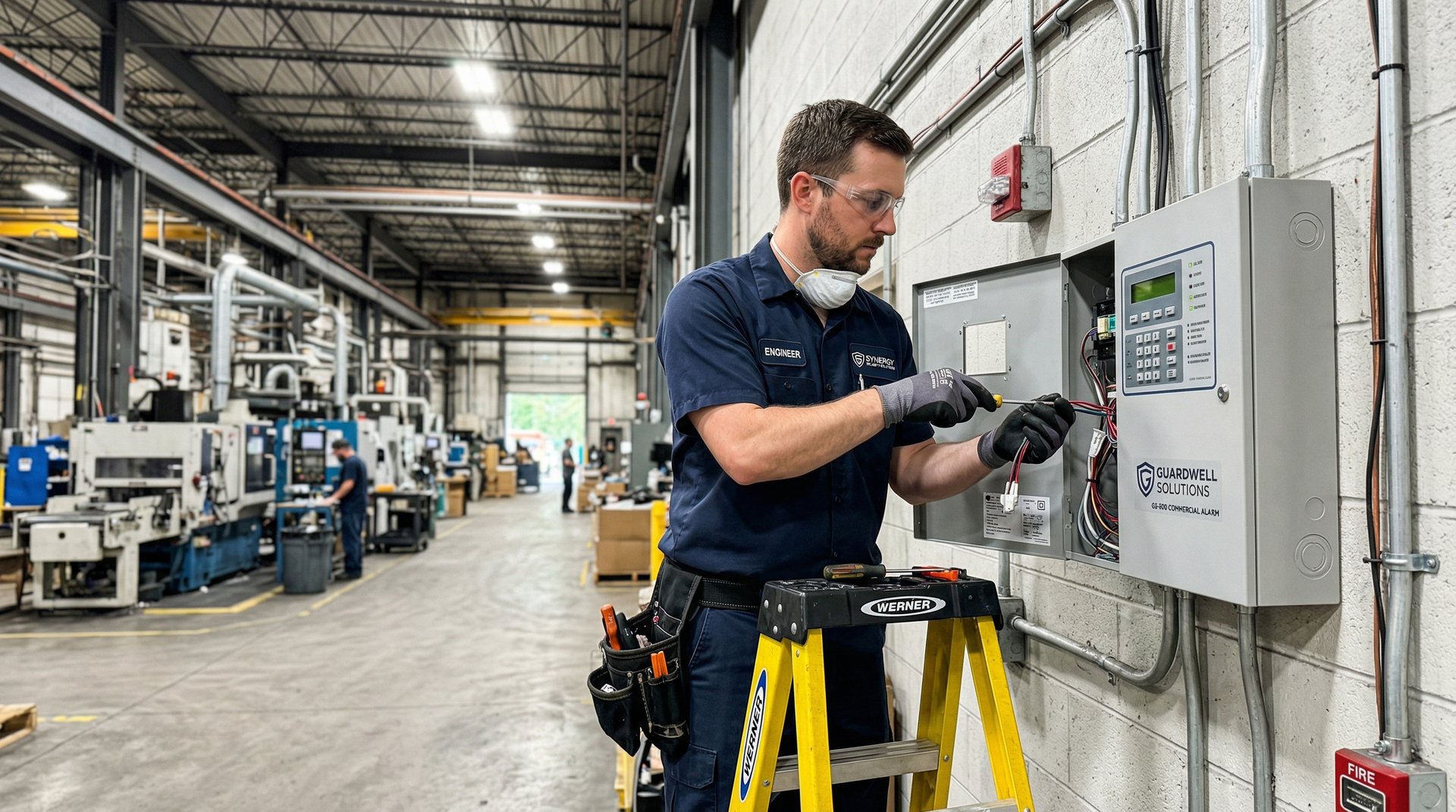
Is Your Alarm Still Working? The PSTN Switch-Off Explained for UK Businesses
BT Redcare closed in December 2025. The PSTN network switches off in January 2027. If your fire or intruder alarm uses an old phone line to signal, it may already be failing silently. Here's what you need to know.
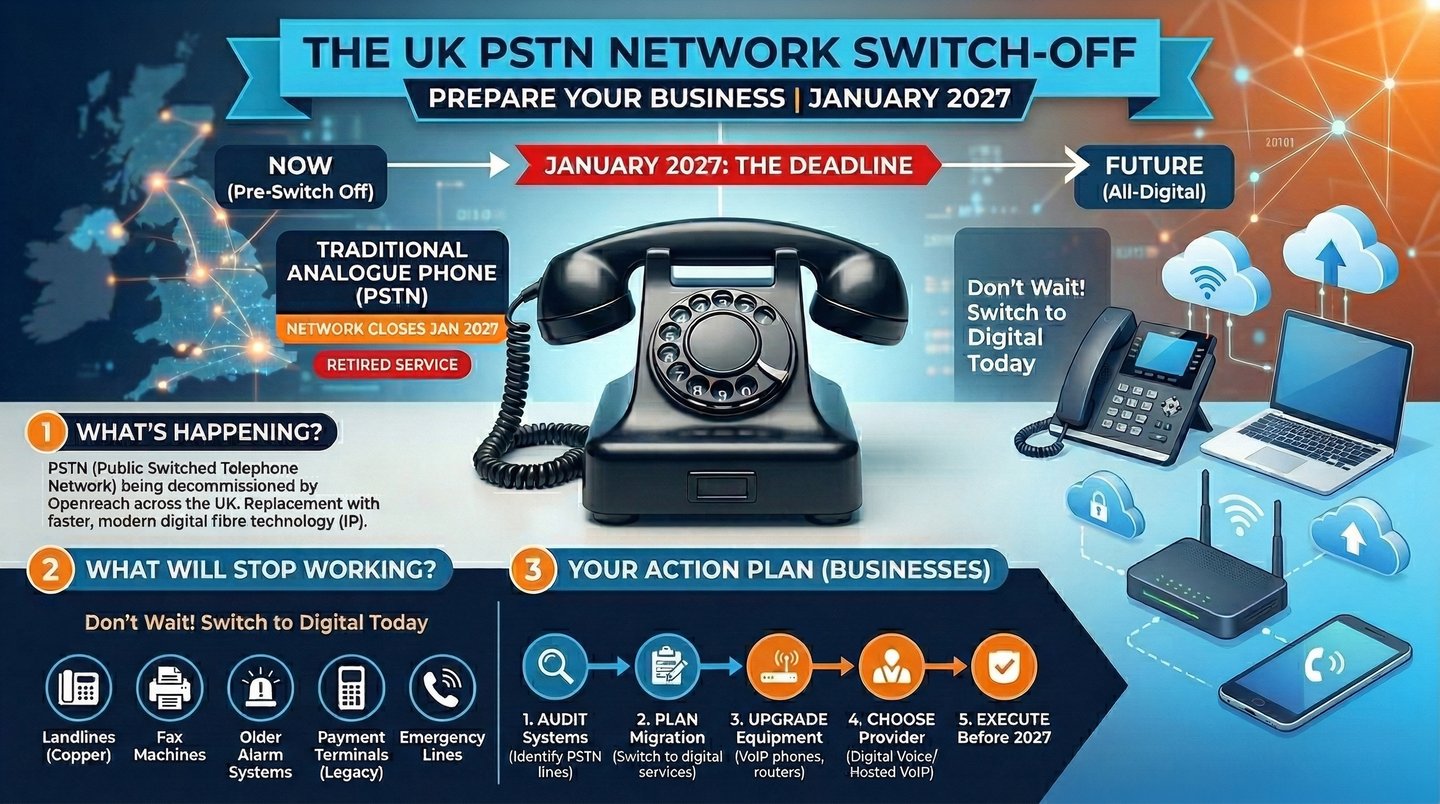

Is Your Business Alarm System Still Working? The PSTN Switch-Off Explained
Here is an uncomfortable question.
When did you last have confirmation that your intruder alarm or fire alarm monitoring is actually communicating with the Alarm Receiving Centre?
Not "the alarm tested fine last month." Not "it went off when I triggered it." But confirmation that the signal pathway from your building to the monitoring centre is intact and functioning right now.
If your system relies on an old BT landline or a legacy signalling service to communicate, there is a real possibility the answer is: you do not know. And in some cases, the system has already stopped communicating entirely.
This is not scaremongering. It is the direct consequence of three overlapping changes to UK telecoms infrastructure that have been rolling out for several years and are now, in 2026, arriving at their most critical phase.
If you have an alarm system that communicates via a traditional phone line, or if you simply do not know how it communicates, then this article is for you.
What Is the PSTN and Why Does It Matter for Your Alarm?
The PSTN (Public Switched Telephone Network) is the analogue copper telephone infrastructure that has underpinned voice and data communications in the UK for well over a century.
For most of that time, it worked quietly in the background, routing phone calls and, critically for businesses, carrying the signals from fire alarms and intruder alarms to Alarm Receiving Centres.
It is estimated that around four million fire and security systems in the UK communicate to Alarm Receiving Centres using the PSTN network.
That is a significant number. And the network those four million systems depend on is being switched off.
The technology underpinning the landline network has been in operation for decades and has reached the end of its serviceable life. The PSTN is failing due to a lack of parts and, increasingly, environmental factors such as storms or heat-related faults. Suppliers are no longer manufacturing spare parts, and repairs now rely on recycling components from decommissioned sections of the network. Ofcom reported that 2024 saw a 45 percent increase in the number of PSTN incidents reported.
The final switch-off date for the UK PSTN network is 31 January 2027, by which point every analogue phone line and ISDN connection in the country will permanently cease to function.
That is the hard deadline. But as we will explain, several related changes have already happened, and if you have not acted, your alarm may already be affected.
Three Changes That Have Already Happened
The PSTN switch-off does not exist in isolation. It is part of a broader shift away from analogue infrastructure, and three specific changes are directly relevant to business alarm systems.
1. BT Redcare Closed in December 2025
This one matters most for businesses with monitored alarm systems, and it is the change that has caught the most people off guard.
BT Redcare was one of the most widely used alarm signalling services in the UK. Thousands of commercial fire alarms and intruder alarms used it to communicate activations to monitoring centres. BT Redcare operations closed in 2025, well before the final 2027 switch-off deadline.
Legacy Redcare systems rely on the "heartbeat" of a PSTN line. If you have not upgraded your alarm dialler to a dual-path GPRS and IP solution, your insurance may be void. Let that sit for a second.
If your alarm uses BT Redcare and you have not migrated to an alternative signalling solution, your system may look operational from the front panel. The alarm will still sound if triggered. But the signal to the monitoring centre, the part that actually calls for help, may not be going anywhere.
Your alarm is, in that scenario, a very expensive noise maker.
If you are not sure whether your system uses BT Redcare, your alarm installer or maintenance contractor should be your first call. This week, not next month.
2. 2G and 3G Mobile Networks Have Been Switched Off
Many alarm systems, particularly those installed or upgraded in the 2010s, were fitted with GSM communicators that transmitted alarm signals over the 2G or 3G mobile network as a backup path, or in some cases, as the primary path.
Many legacy alarm communicators and wireless security devices still rely on 2G or 3G connectivity. Some legacy systems will not notify the GSM unit when the SIM card has stopped communicating. This is one of the most common causes of silent system failure in older monitored alarm systems.
"Silent system failure." That phrase deserves emphasis. The system appears to work. It tests fine. The engineer visits and finds no fault on the panel. But the communication path, the thing that actually connects it to help, has gone.
The UK's major mobile networks completed their 2G and 3G switch-offs in 2024 and 2025 respectively. Any system relying on those networks for signalling is now operating without that communication path.
3. The Digital Stop-Sell Is Already Active
There is also an earlier practical milestone. Providers such as BT have encouraged businesses to migrate to digital services by the end of 2025, to encourage businesses to allow sufficient time rather than rushing at the last minute.
In practical terms, in many exchange areas, the "stop-sell" is already active, meaning no new PSTN or ISDN services can be purchased, and no system takeovers or modifications involving PSTN lines are permitted.
This means that even if you wanted to maintain your existing PSTN-dependent alarm signalling, you may not be able to do so when it next requires modification or takeover by a new contractor.
What Does This Mean for Your Alarm System in Practice?
The practical implications depend on how your alarm system currently communicates. Most business alarm systems use one of the following signalling methods, or a combination.
PSTN only (single analogue phone line)
If your system signals via a dedicated analogue phone line and nothing else, it is now operating on infrastructure that is actively deteriorating and will be switched off entirely by January 2027. In some exchange areas, the service has already been disrupted. Your monitoring is unreliable at best, absent at worst. This needs upgrading as soon possible.
BT Redcare (any variant)
As noted above, BT Redcare closed in December 2025. If this was your signalling method and you have not migrated, your monitoring is already gone. Contact your installer or maintenance contractor immediately.
2G or 3G GSM (single path)
The mobile networks these communicators relied on have been switched off. Your GSM communicator may still appear to function; it will power on, it will register to a network, but it may be registering to a 4G network that it is not configured to use correctly, or failing silently. Either way, your signalling is unreliable. An upgrade to a 4G or dual-path communicator is required.
Dual-path IP and GSM (2G/3G)
Many systems installed or upgraded in recent years used IP as the primary signalling path and 2G/3G GSM as the backup. The IP path may still be functioning, but the 2G/3G backup has gone. You are now operating on a single path, which reduces your system's resilience and may affect your insurance compliance and police response eligibility.
Dual-path IP and 4G LTE
If your system uses IP over your broadband connection and 4G LTE as a backup, you are in the best position. Your signalling paths are both on infrastructure that remains active. However, your PSTN landline (if your system is also connected to one) will still need addressing before January 2027.
Alarm Signalling Grades and Why This Matters for Your Insurance
This is a part of the conversation that most business owners are not aware of, but it is directly relevant to your insurance cover and, where applicable, your police response eligibility.
Alarm signalling grades, designated DP1 through DP4, define how quickly a fault in communication between a business alarm system and the Alarm Receiving Centre is detected. This is a critical factor for police response eligibility, insurance compliance, and system resilience.
Here is what those grades actually mean in practice:
Legacy DP1 signalling, which can take up to 25 hours to detect a path failure, is now widely regarded as unsuitable for commercial premises. DP2 signalling improves detection to approximately 31 minutes, but still leaves a significant exposure window. Modern business security systems increasingly adopt DP3 or DP4 signalling, where communication failures are detected within 4 minutes or 3 minutes respectively.
Think about that from a practical standpoint. If your system is running DP1 signalling and the communication path fails at 9pm, you might not know until 10pm the following evening. An entire overnight period during which your premises appears to be monitored but is not.
For most commercial insurers, the minimum acceptable signalling grade has been quietly moving upward. If your system still uses older signalling, your alarm may look operational but not actually be communicating; a growing issue with legacy systems affected by PSTN, 2G, and Redcare switch-offs.
If you are unsure what grade your system operates at, that is a conversation to have with your installer or maintenance contractor. And if you do not have a maintenance contractor, that is a separate problem worth addressing.
What Does a Compliant, Future-Proof Alarm Signalling Solution Look Like?
The good news is that the replacement technology for all of the above is mature, reliable, and widely available.
A modern, future-proof signalling solution for a commercial or industrial alarm system typically involves:
Dual-path signalling over IP and 4G LTE. Two independent communication paths, one over your broadband connection, one over the 4G mobile network. This provides resilience against either path failing. Two independent transmission paths are now considered the baseline for a properly resilient commercial alarm signalling setup.
DP3 or DP4 grade signalling. As discussed above, higher grades mean faster fault detection and better insurance compliance. Most modern dual-path communicators support DP3 or DP4 as standard.
A modern digital communicator. The legacy signalling device in your alarm panel almost certainly needs replacing if it was originally designed for PSTN, 2G, or 3G operation. In many cases this is a relatively straightforward upgrade that does not require replacing the entire alarm panel.
Connection to a BS 5979 Category II compliant ARC. Your new signalling solution should connect to a monitoring centre that meets the relevant British Standard. Not all monitoring centres are equal, and the BS 5979 Category II designation is the benchmark for commercial monitoring.
What About Your Fire Alarm?
Everything above applies equally to fire alarm systems that use remote signalling to an ARC or to the fire and rescue service.
There are a range of devices and systems affected by the PSTN switch-off that could impact your business, including fire and other types of alarms.
If your fire alarm uses PSTN-based signalling, the same urgency applies. In some respects, it is even more critical. A fire alarm monitoring system that fails silently during an overnight fire at an unoccupied premises is a scenario with potentially catastrophic consequences.
Your fire alarm's signalling arrangements should be reviewed as part of your next annual fire alarm service visit at the very latest. If your system is due a service, raise this explicitly with your engineer.
Do You Actually Know How Your Alarm Signals?
This is, if we are being honest about it, the most important question in this entire article.
A significant proportion of businesses have alarm systems that were installed or upgraded several years ago and have been maintained by a contractor ever since. The business owner knows the system is there, knows it is serviced, and assumes it is working. The specific signalling technology it uses, and whether that technology is still functional, is not something they have ever had reason to think about. That assumption is now risky.
Here is a straightforward checklist for getting clarity on your current position:
Find your alarm maintenance certificate. Your last service visit should have produced a written certificate. Look at it. Does it mention the signalling path, communicator type, or ARC connection? If it mentions BT Redcare, PSTN, or a GSM communicator with no 4G or IP reference, that is a flag.
Call your installer or maintenance contractor. Ask them directly: what signalling method does my system use? Is it still communicating to the ARC? Has the communicator been upgraded for the PSTN switch-off? A reputable contractor should be able to answer these questions immediately.
Check your insurance policy. Look at the security conditions in your commercial insurance. Many policies specify minimum signalling standards. If your system no longer meets those standards because of network changes, your cover may be compromised.
Ask your ARC for a connection report. If you know who monitors your alarm, ask them to confirm your system is currently communicating correctly. A good monitoring centre will be able to tell you when your system last made a successful test call and what the current status of your connection is.
If any of those steps reveal a problem, the action is the same: contact a qualified alarm installer and get a signalling upgrade scoped and scheduled. In most cases, the work is not dramatic, a communicator swap, a reconfiguration, and a recommission. But leaving it until the hard deadline in January 2027 risks running into a bottleneck of businesses all trying to do the same thing at the last minute.
Engineering shortages are expected to peak in the third and fourth quarters of 2026. Businesses that wait until the final six months will face premium installation costs and significant lead times.
The Bigger Picture: This Is Not Just a Telecoms Problem
It would be easy to file this away as a telecoms infrastructure issue, something for your IT department or phone provider to sort out.
But it's not. It is a fire safety and security compliance issue with direct implications for your insurance, your legal obligations under the Regulatory Reform (Fire Safety) Order 2005, and the actual physical security of your premises.
The businesses most at risk right now are the ones that have what looks like a fully functional alarm system but have never had the signalling technology examined in the context of these network changes. Everything looks fine on the surface. The panel shows normal. The engineer signed off the last service. The invoice is filed.
But the communication path that makes the system genuinely useful in an emergency, the path that calls for help may no longer work.
That gap between appearance and reality is worth closing. Quickly, and before someone else points it out for you under less comfortable circumstances.
FIDEC Security Solutions Ltd installs, upgrades, and maintains commercial intruder alarm and fire alarm systems for businesses across England. If you are not sure whether your alarm signalling is still compliant, call us on 0333 3662 007 or email info@fidecss.co.uk. We will give you a straight answer.

CONTACT US


© 2026 FIDEC Security Solutions Limited is a company registered in England and Wales. Company Registration Number: 13305120.
VAT Registration No: 405272229.
All rights reserved.
Privacy Policy | Cookie Policy
OPENING HOURS
MON – 08:00 - 17:00
TUES – 08:00 - 17:00
WEDS – 08:00 - 17:00
THURS – 08:00 - 17:00
FRI – 08:00 - 17:00
SAT – Closed
SUN – Closed